

The Importance of Radial Float in Blind-Mate Liquid Cooling Quick Connectors
As AI computing, high-performance computing (HPC), and high-density electronic systems continue to develop, liquid cooling is becoming increasingly important for managing the heat generated by high-power components.
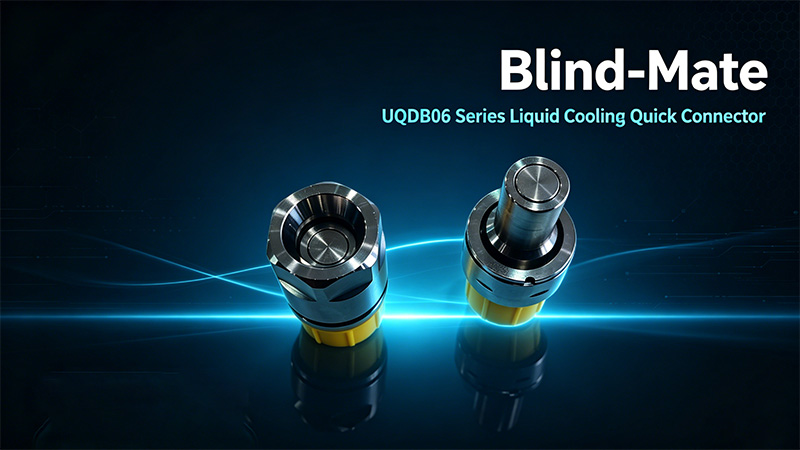
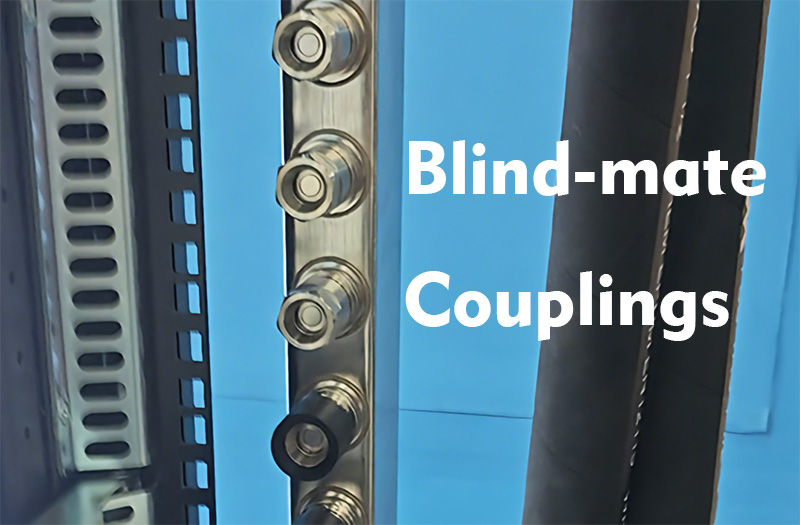
Liquid cooling quick connectors provide reliable interfaces for connecting cooling circuits while allowing equipment to be installed, removed, and serviced efficiently. In high-density systems where connection points may be hidden or difficult to access, blind-mate liquid cooling connectors offer additional flexibility for equipment integration and maintenance.Unlike conventional connectors that require direct visual alignment, blind-mate connectors are designed to engage when the plug and socket cannot be directly observed or perfectly aligned during insertion. This makes them particularly valuable for applications such as data centers, HPC systems, semiconductor equipment, radar systems, high-energy physics equipment, and solid-state power electronics.
However, reliable blind mating requires more than flow performance and sealing capability. The ability to accommodate positional deviation is also an important consideration in blind-mate connector design.
One of the mechanisms used to address this requirement is Radial Float.
What Is Radial Float?
Radial Float refers to the ability of a connector interface to accommodate a defined amount of displacement in the radial direction during mating.In practical equipment, perfect alignment between the plug and socket cannot always be guaranteed. Manufacturing tolerances, mounting tolerances, accumulated assembly deviations, and small relative movements between components can result in radial misalignment.
A floating connector structure allows the mating interface to accommodate a certain degree of such displacement. This provides greater alignment tolerance and can facilitate smoother engagement when the initial position of the plug and socket is not perfectly aligned.
For blind-mate liquid cooling applications, this capability can be particularly valuable because the operator or automated equipment may have limited visibility of the connection interface.
Why Is Radial Float Important?
1. Compensation for Manufacturing and Assembly Tolerances
Manufacturing and assembly tolerances are unavoidable in complex equipment.In a liquid cooling system, the relative position of server modules, cooling manifolds, cold plates, mounting structures, and connector interfaces can be affected by multiple dimensional tolerances.
When these tolerances accumulate, the plug and socket may not be perfectly aligned during mating.
Radial Float provides additional positional tolerance by allowing the connector interface to accommodate radial displacement. This can reduce the precision requirements of the surrounding mechanical structure and provide greater flexibility during equipment assembly.
2. Facilitating Blind Mating and Self-Alignment
Blind-mate applications typically involve connection points that are hidden from direct view.For example, a server module may need to connect to a cooling manifold or backplane interface as it is inserted into a rack. In such situations, precise visual alignment may not be practical.
A radial floating mechanism allows the connector to accommodate a defined amount of positional deviation during insertion. When combined with appropriate guiding features and connector geometry, this can facilitate smoother engagement between the plug and socket.
This creates a more forgiving connection interface for applications where precise alignment is difficult to achieve.
It is important to note that the actual self-alignment capability depends on the overall connector design, including guiding geometry, floating mechanism, mating structure, and available alignment tolerance.
3. Reducing Mechanical Stress on Sealing and Mating Components
Misalignment during mating can generate additional lateral forces and mechanical stress on connector components.Repeated mating under excessive misalignment may increase mechanical loading on sealing elements, valves, locking structures, and mating surfaces.
By providing a degree of radial movement, a floating mechanism can accommodate positional deviation and help reduce excessive mechanical loading associated with misalignment.
This can help protect critical connector components and support long-term connection reliability.
However, Radial Float should not be considered a standalone guarantee against leakage or component wear. Overall sealing and durability performance also depend on factors such as seal geometry, material selection, operating pressure, temperature, surface conditions, connector design, and operating environment.
4. Supporting Automated and Robotic Assembly
As liquid cooling systems become increasingly modular and automated, connectors may need to interface with automated assembly equipment or robotic systems.In these applications, the actual position of mating components may vary within a defined tolerance range.
A connector with appropriate radial float capability can accommodate a certain degree of positional deviation, reducing the need for extremely precise positioning of the mating components.
This can support applications involving:
--Automated equipment assembly
--Robotic installation and maintenance
--Modular cooling systems
--High-density server racks
--Limited-access connection interfaces
The suitability of a connector for automated assembly depends on the complete system design, including mating force, positioning accuracy, guiding mechanisms, retention, cycle life, and other mechanical parameters.
5. Accommodating Small Relative Movements During Operation
Liquid cooling equipment can experience small relative movements during operation due to vibration, thermal expansion and contraction, or other mechanical effects.For example, changes in operating temperature may cause different components to expand or contract at different rates. Mechanical equipment may also experience vibration generated by pumps, fans, or other operating components.
Radial Float can provide additional positional tolerance for certain small relative movements within its designed range, helping reduce excessive mechanical loading at the connector interface.
This can contribute to stable mechanical connection performance over repeated operating cycles.
However, Radial Float is not a substitute for dedicated vibration isolation or thermal expansion compensation. These functions should be addressed through the overall mechanical and thermal design of the system.
Radial Float as Part of Overall Connector Design
For liquid cooling quick connectors, particularly blind-mate designs, Radial Float is an important consideration—but it should not be evaluated independently.A comprehensive evaluation of a liquid cooling quick connector should consider multiple performance parameters, including:
--Flow rate
--Pressure drop
--Maximum working pressure
--Leakage performance
--Mating and unmating force
--Radial and axial misalignment tolerance
--Sealing performance
--Cycle life
--Operating temperature
--Material and coolant compatibility
--Locking and retention performance
The appropriate combination of these parameters depends on the requirements of the specific cooling system.
For blind-mate applications, however, sufficient alignment tolerance can provide an important engineering advantage because the connector must accommodate installation conditions where perfect visual or mechanical alignment may not be possible.
Designed for Blind-Mate Liquid Cooling Applications
Blind-mate liquid cooling quick connectors are particularly useful when the cooling interface is located in a concealed or difficult-to-access position.Typical or potential applications include:
--Data centers
--AI computing infrastructure
--High-Performance Computing (HPC) systems
--Semiconductor equipment
--Radar and high-power electronic systems
--High-energy physics equipment
--Solid-state power electronics
These applications often require compact integration, reliable connections, efficient maintenance, and repeatable installation.
By incorporating an appropriate floating mechanism into the connector design, manufacturers can provide additional tolerance for real-world assembly conditions and positional variation.
Engineering Benefits of Radial Float
When properly integrated into a blind-mate liquid cooling connector, Radial Float can provide several engineering benefits:--Greater alignment tolerance
--Helps accommodate manufacturing, mounting, and assembly deviations.
--Facilitated blind mating
--Allows the connector to accommodate positional deviation when the interface is not directly visible.
--Reduced mechanical loading
--Helps manage lateral forces associated with connector misalignment.
--Greater integration flexibility
--Provides additional tolerance when incorporating cooling interfaces into compact equipment.
--Support for automated assembly
--Can provide additional positional tolerance for automated or robotic mating processes when combined with appropriate guiding and positioning systems.
These benefits make Radial Float an important design consideration for liquid cooling connectors used in high-density and limited-access environments.
Conclusion
As liquid cooling becomes increasingly important in high-density computing and advanced electronic systems, the requirements for liquid cooling quick connectors continue to evolve.For blind-mate applications, reliable connection depends not only on flow capacity, pressure rating, and sealing performance, but also on the connector's ability to accommodate positional deviation.
Radial Float provides a defined degree of radial alignment tolerance, helping compensate for manufacturing and assembly deviations and facilitating blind mating. It can also help reduce excessive mechanical loading caused by misalignment and provide additional tolerance for certain small relative movements during operation.
Rather than being a standalone performance indicator, Radial Float should be considered as part of the overall mechanical design and reliability strategy of a liquid cooling connector.
For applications where installation space is limited, direct visual alignment is difficult, or automated mating is required, an appropriately designed floating mechanism can provide greater installation tolerance and integration flexibility.
Designed for blind mating. Engineered for alignment tolerance. Built for reliable liquid cooling connections.
Message
If you are interested in our products, please fill in the message form below. Our sales representative will contact you within 24 hours.